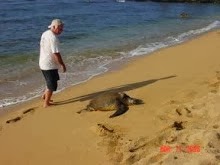
The sea turtle's body is wonderfully adapted to life in the ocean. Their shells are lighter and more streamlined than those of their terrestrial counterparts, and their front and rear limbs have evolved into flippers making them efficient and graceful swimmers, capable of swimming long distances in a relatively short period of time. Sea turtles have been known to move through the water as fast as 35 mph. When active, sea turtles swim to the surface every few minutes in order to breathe. When sleeping or resting, which usually occurs at night, adult sea turtles can remain underwater for more than 2 hours without breathing. This is due to the fact that turtles are capable of containing higher concentrations of carbon dioxide in their blood than most other air-breathing animals, enabling them to use their oxygen very efficiently. Both muscles and blood are able to store oxygen in large quantities, allowing sea turtles to remain underwater for such long periods of time. Juvenile sea turtles have not developed this ability as well as adults and must sleep afloat at the water's surface.
Unfortunately, not all of the hatchlings reach the ocean. Many are snatched up by hungry crabs and other predators along the way or become lost and die. In addition, some are eaten by sharks and other carnivorous fishes while at sea. Only a few baby turtles from each nest will survive into adulthood. This type of a life history strategy exhibited by the green sea turtle can perhaps be more easily understood by comparing it to other patterns that we see in nature.
There were once several million green sea turtles worldwide. Today, fewer than 200,000 nesting females are thought to remain. In Hawaii, scientists currently estimate that only 100 to 350 females nest each year, predominantly at French Frigate Shoals in the Northwest Hawaiian chain.
If you have more turtle facts, please post your comment so we can continue to build the site. The information gathered for this article was taken from EarthTrust.org.
Thursday, July 30, 2009

Sunday, July 26, 2009
The death of Alii Beach Honu

Got a call this am about the siting of a dead turtle. Here's what we found

She appears to have died from natural causes. She was maybe 120lbs or so and maybe 10-15 years old (all field guesses). However, those four or more cut lines across her back may be a propeller blade, but someone else will have to make that call to be certain.


After we called the turtle hot line at 808-288-0023 (which is a pager) we left our number and waited for NOAA to call back.


Janea Howell was assigned to our turtle. She came out and we put her on a canvas. Uh . . . the turtle not Janea.


Then we began hauling her up the beach to Janea's waiting SUV.


Mind you that's an SUV. That girl (the turtle, not Janea) was stink. And Janea had to drive all the way to town with this lady in the back of her car. I hope she made it all the way to town. Wow, what a job. I hope that she had her car detailed today.
Monday, June 22, 2009
Turtle in Distress

Here Riley & Kelly Peterson, and mom all from San Diego find a turtle with an Ulua hook in its neck. Looks like the hook has been in the turtles neck for many years. So they came back to the condos to find help and see who could remove the hook. I was notified. After confirming the injury and taking pictures, I made a call to NOAA and waited for a response. They didn't call right away so I took caution to remove the hook as carefully as I could.

This is a close up of the hook still in the turles neck

Together with Peter from Boston, who was also staying at our condos, held the turtle from moving, I pulled the hook out. Because the hook was so rusted, I figured that the hook had been in his neck for a number of years, it seemed that the Turtle bodys natural protection and healing process would have wrapped the hook and I was right. The hook came out just like pulling a cork out of a bottle of vintage wine. "PoP"! and all was good.

Then I massaged his neck. After that, he seemed to tilt his head to look at me, with a sparkle in his eyes. He then turned to the ocean and decided to go swimming. I think he juss wanted to go show his friends that he wasn't wearing his "Bling" any more.

There he goes, happy and satisfied with the surgury. You can see that it's a He turtle because of the size of his tail. Wahine's have short tales.

He even really wasn't too much in a hurry to get back in the ocean. I'm sure he'll feel a lot better tomorrow.

Here's a close up of what the hook looked like. I kept the hook to send into NOAA for their inspection and documentation.
Monday, March 2, 2009
Condo Turtle into log snuggling 3-2-9

I wish I could get closer to you, but I can't. Please Log . . . tell me U love me! We could marry and make little Turtlelogs

The Haleiwa Surf Condominiums are right there. I'll protect you, I won't let them use U as fire wood!

Monday, February 2, 2009
Feb 2009 Honu

My Doctor said I needed to spend more time out of the water!

He said I should spend more time at the Beach

My tail is getting kinda heavy.


I'm suppose to stay at the Haleiwa Surf condo's. Has anybody seen it?
Tuesday, January 13, 2009
1-12-09
.jpg)
Look at me, not the camera
.jpg)
.jpg)
I heard they got affordable rent over here! I wonder if they allow pets? I think I'd like to bring my human!
Tuesday, December 2, 2008
Photographer Terry Partlon photo's of NS Turtles
A new shop opened up in Haleiwa in October 2008. Terry Partlon shoots Turtles as well as other sea creatures for your viewing pleasure. See his web site at: http://www.turtlesandmoregallery.com He's located in Haleiwa next to Grass Skirts on the mauka side of Kamehameha Hwy in the heart of Haleiwa (also across from Stortos Deli) or at 66-218 Kamehameha Hwy, in Haleiwa. And since this is a Turtle Blog spot for Haleiwa, I wanted to highlight his work. Terry can be reached at 808-741-3510.
Subscribe to:
Posts (Atom)